
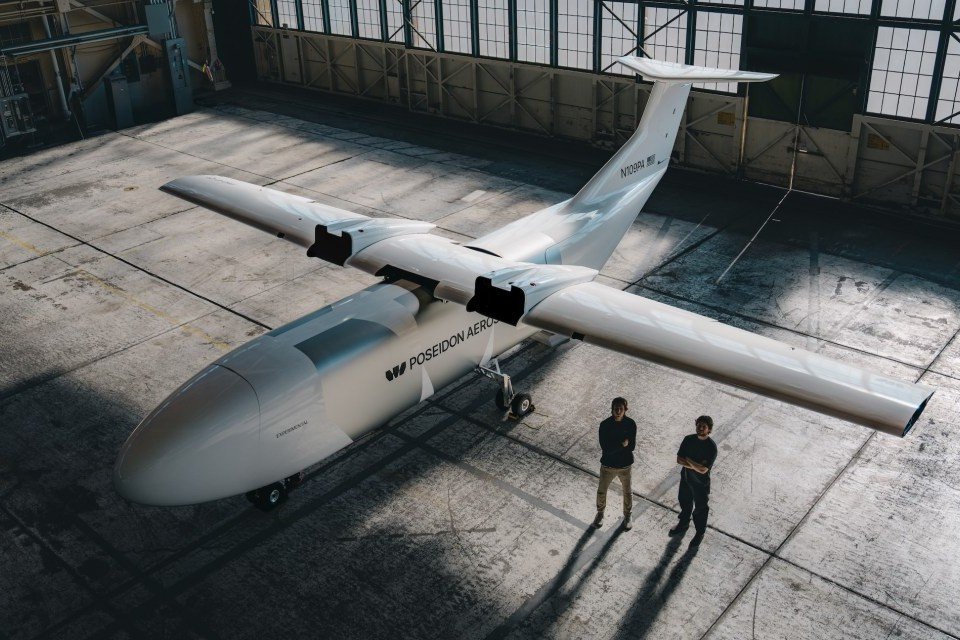
Poseidon Aerospace, a company focused on improving cargo logistics, has closed a $60 million Series A funding round. This investment comes ahead of the first test flight for its uncrewed cargo plane, Egret, expected by the end of this year. The company previously secured $11 million in seed funding last year.
What is Poseidon Aerospace and Its Goal?
Co-founders David Zagaynov and Parker Tenney started Poseidon Aerospace after realizing that many advanced air mobility startups focused on new, flashy technologies. Zagaynov, who worked in logistics at Amazon, and Tenney, from Lockheed Martin, aim to build the future of aerologistics by directly improving cargo transport. Their stated goal is to lower the cost of moving cargo, not to be “nerd-sniped” by complex, unproven technologies.
Poseidon’s Aircraft Technology and Design
True to its philosophy, Poseidon Aerospace is taking a pragmatic approach to aircraft design. The company is not using vertical takeoff and landing (VTOL) technology, nor are its planes hydrogen or electric powered. Instead, its fixed-wing aircraft, Egret and its seaplane variant Heron, run on standard combustion engines. Zagaynov highlighted that it is difficult to beat the energy density of carbon-based fuels, emphasizing the focus on building a simple, efficient cargo box with wings to move things cheaply.
Target Markets and Business Model
Poseidon Aerospace is initially targeting two key areas: defense and regional commercial cargo. For defense, the startup is designing aircraft to service remote communities and underserved routes, enhancing a nation’s logistical resilience. On the commercial side, Poseidon plans to operate its own regional air cargo business. This strategy aims to compete directly with existing carriers for business from companies like UPS and FedEx, rather than selling its planes.
The Advantage of Uncrewed Aircraft Operations
Not requiring pilots allows Poseidon to operate at a lower cost curve and achieve higher aircraft utilization. Zagaynov explained that logistics is a commodity, and doing it “better, faster, cheaper” can capture demand. Uncrewed planes also offer flexibility, allowing for easier route changes to meet demand spikes without relying on a fixed pool of pilots. This model could enable more point-to-point trips, moving away from the traditional hub-and-spoke system in regional air cargo. Eliminating the cockpit and life support systems also reduces structural weight, leading to lighter, more efficient designs and engines.
Funding Details and Future Plans
The $60 million Series A round was led by TQ Ventures, with new investments from Hanwha Asset Management, G Squared, and JAWS. Existing backers Starship Ventures, Draper Associates, and Drover Ventures also participated. Poseidon Aerospace has expanded into an old Navy hanger in Alameda, California, to build its full-size, 50-foot-wingspan Egret aircraft, following the successful flight of a quarter-scale model (Seagull) last year. The company is set for a hiring spree as it prepares for the first full-scale test flight. While not directly in the electric VTOL space, Poseidon benefits from a regulatory environment, including new FAA pilot programs, that is more open to innovative aviation solutions than in previous years.
Leave a Reply