
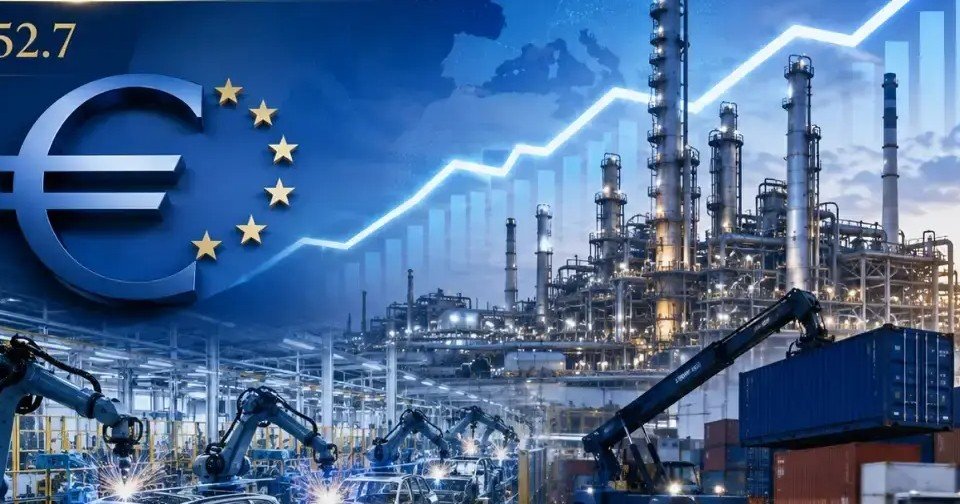
Eurozone manufacturing activity grew at its fastest pace in over four years in August, fueled by a significant rise in new orders and strong factory output. The S&P Global Eurozone Manufacturing Purchasing Managers’ Index (PMI) reached 52.7 in August, up from 51.9 in July. A reading above 50 indicates expansion.
This latest data suggests the region’s industrial sector is recovering from challenges like higher oil prices and supply issues linked to the Middle East conflict. New orders saw their strongest growth since early 2022, and export orders increased for the second time in four and a half years, with notable demand from Austria, Germany, and the Netherlands.
Factory output also improved, with the output sub-index climbing to a 54-month high of 53.3 in August. Production increases were largely seen in intermediate goods such as chemicals, metals, and electronic components. Germany experienced its strongest manufacturing expansion in over four years, while France also contributed to the growth. However, Italy and Spain reported manufacturing contractions.
The labor market showed signs of stabilization, with manufacturing employment remaining largely unchanged in August after more than three years of declines. Price pressures eased, with input cost inflation dropping to a six-month low, though still higher than pre-conflict levels. Output price inflation followed a similar trend.
While these developments could help ease inflation concerns, producer price indicators remain above pre-conflict levels. This comes ahead of expected official figures showing a rise in Eurozone consumer price inflation to 3.3% in August from 2.9% in July. Higher energy prices continue to complicate the European Central Bank’s efforts to reach its 2% inflation target, with economists anticipating further interest rate hikes.
Despite inflation risks, manufacturers are more optimistic about the future, with business confidence improving for the fourth consecutive month. Expectations for activity in the next 12 months have risen above the sector’s long-term average. The stronger order pipeline and improved confidence suggest momentum in the manufacturing recovery, though elevated energy costs and varied performance across major economies remain key concerns.
Leave a Reply