
Key Takeaways
- Tesla CEO Elon Musk unveiled a “flying” Roadster prototype, equipped with high-pressure gas thrusters, at a SpaceX event in Texas.
- Slated for 2028 production, the vehicle faces significant regulatory uncertainty, with no clear government oversight agency identified.
- Analysts, including Dan Ives, view the Roadster primarily as a brand-halo product rather than a near-term revenue or volume driver for Tesla.
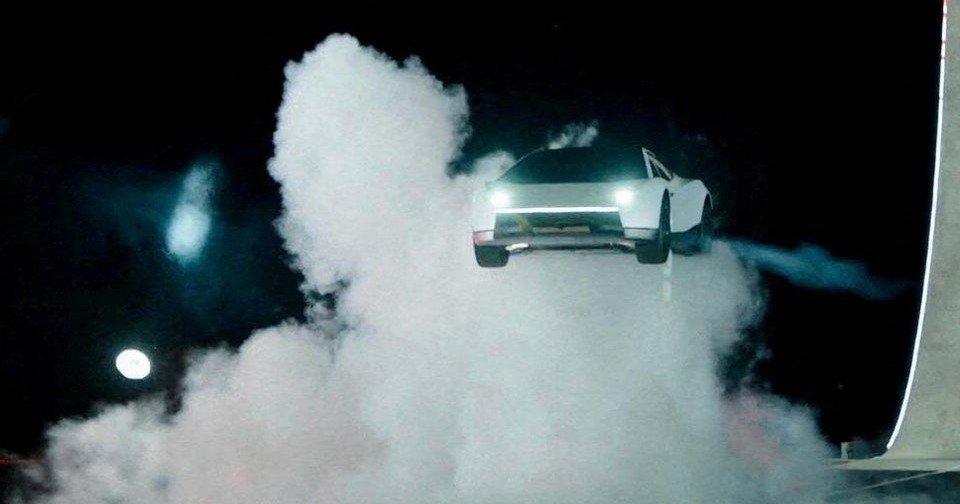
Tesla CEO Elon Musk unveiled what he described as a “flying” car, the new Roadster sports model, during a livestreamed event at his SpaceX rocket company’s facility in Waco, Texas, on October 15, 2026. The demonstration showcased the vehicle launching from a ramp, appearing to defy gravity before flying off, rolling 180 degrees midair, and landing on its wheels. Musk stated the car was equipped with “ultra high-pressure air tanks” to propel itself, touting it as a collaboration between Tesla and SpaceX, with production targeted for 2028.
What Did Tesla Unveil and When?
Tesla’s long-delayed new Roadster, using high-pressure gas boosters, was revealed on October 15, 2026, at a SpaceX test facility in Waco, Texas. The demonstration, livestreamed on Tesla’s X account, featured the vehicle’s “full flight system” prototype, which Musk claims will enable short bursts of flight. While specific pricing was not disclosed, Musk indicated production could commence in 2028. Prospective buyers can place a $5,000 deposit for a non-flying model, but the “Rocket model” with its flight system is promised by invitation only.
What Are the Regulatory Challenges for a Flying Car?
The unveiling immediately cast a spotlight on the complex and undefined regulatory landscape for such a vehicle. Tesla’s website explicitly notes that the planned flying model is “not approved for public road use.” U.S. Transportation Department officials have expressed skepticism regarding its ability to truly take off, and no government agency has claimed clear oversight. The National Highway Traffic Safety Administration (NHTSA), which typically regulates vehicles, delegates safety certification to automakers but did not comment on this specific model. Crucially, the Federal Aviation Administration (FAA) told CBS News that the vehicle, in its current form, does not meet the agency’s definition of an aircraft. This regulatory void presents a substantial hurdle for any eventual public deployment or commercialization.
How Will the Roadster Impact Tesla’s Financials?
Wall Street analysts largely agree the “flying” Roadster will not significantly move Tesla’s financial needle in the near term. Dan Ives, a prominent analyst at Yorkville Ives, noted in a research report that the Roadster “will not move the volume or revenue needle, with production likely limited, and investors should not model it as a growth driver.” Instead, Ives highlighted the car’s role in “restor[ing] the brand halo at the top of the market and put[ting] a spotlight on the engineering stack a week before the FY3Q26 print on October 21st.” The high-end, limited-production model is expected to primarily serve as an innovation showcase rather than a mass-market sales driver.
The SpaceX-Tesla Synergy: Beyond the Roadster
The Roadster’s development underscores a growing collaboration between Tesla and SpaceX, a dynamic Elon Musk emphasized. Analyst Dan Ives remarked that the new vehicle “puts the Tesla and SpaceX relationship on the table in a tangible way, with propulsion, pressure-vessel, and control hardware developed at the rocket company sitting on a Tesla product.” Ives views this as strengthening “the case for the two companies operating as one engineering platform over time.” This synergy extends beyond the Roadster; SpaceX recently announced plans to acquire licenses for radio airwaves to expand its Starlink Mobile satellite business into cellular service, potentially making it a “major mobile carrier in the U.S.,” according to Musk’s October 8 social media post.
Analyst Perspective & Market Impact
Financial analysts are largely convergent on the view that the ‘flying’ Roadster, while a remarkable engineering feat, will not translate into significant immediate revenue or volume for Tesla. Yorkville Ives analyst Dan Ives explicitly stated it should not be modeled as a growth driver. The market impact is expected to be more qualitative, reinforcing Tesla’s innovative brand image and highlighting the deep technological collaboration between Tesla and SpaceX. This public demonstration ahead of Tesla’s FY3Q26 earnings on October 21st serves as a strategic move to focus investor attention on the company’s long-term engineering capabilities and vision, potentially offsetting any short-term market anxieties.
| Factor | Description |
|---|---|
| Strengths | Showcases advanced engineering collaboration between Tesla and SpaceX; enhances brand innovation and “halo effect” for Tesla at the top of the market. Utilizes high-pressure gas thrusters, a novel propulsion system for road vehicles. |
| Weaknesses | Unlikely to be a significant volume or revenue driver for Tesla due to limited production; high development costs for a niche product; current lack of clear regulatory oversight for flight systems. |
| Opportunities | Pioneering future mobility concepts; potential to influence development of advanced materials, battery technology, and regulatory frameworks for next-gen vehicles. Strengthens integrated engineering platform narrative for Tesla and SpaceX. |
| Threats | Protracted regulatory approval processes could delay or halt commercialization; public safety concerns; significant capital allocation to a non-core product; competition from established eVTOL players and other advanced mobility startups. |
Will the technological audacity of Tesla’s flying Roadster overcome the complex labyrinth of regulatory approval and public acceptance, or is this ultimately a strategic brand-building exercise and a display of engineering prowess ahead of critical earnings? The market awaits clarity on its real-world viability.
Leave a Reply