
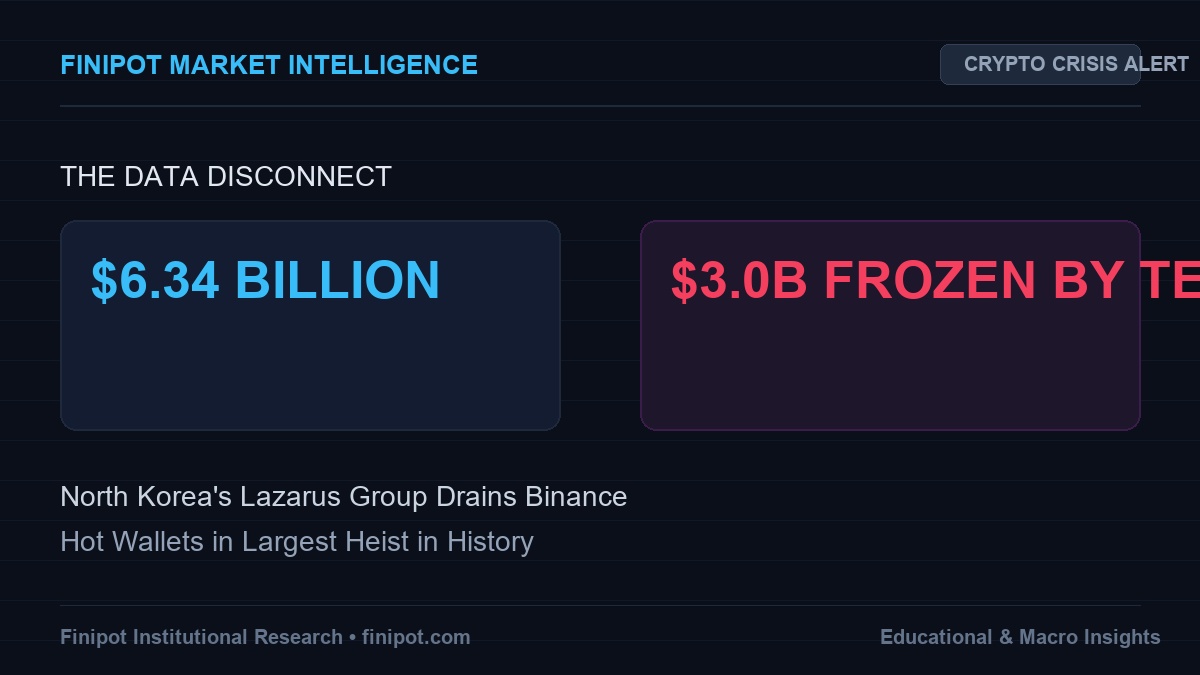
SINGAPORE & NEW YORK — October 30, 2026 — In what blockchain analytics firms have officially confirmed as the largest cyber heist in financial history, cryptocurrency exchange Binance was struck by a sophisticated exploit that drained approximately $6.34 billion in digital assets within a span of just 20 minutes.
The attack, which began late on October 29 at approximately 20:05 UTC, targeted hot wallets across multiple chains including Ethereum, Bitcoin, Solana, XRP Ledger, and Tron. Independent cybersecurity intelligence firms—including TRM Labs, Chainalysis, and on-chain sleuth ZachXBT—have attributed the breach with high confidence to TraderTraitor, an elite cyber warfare unit operating under North Korea’s state-sponsored Lazarus Group.
Critical Incident Summary
- Total Stolen Capital: Estimated at $6.34B to $6.40B across major layer-1 hot wallets.
- Capital Frozen: Roughly $3.0B in USDT and USDC successfully blacklisted by Tether, Circle, and layer-1 security councils.
- Attack Vector: Compromised DevOps engineer workstation used to hijack containerized withdrawal signing routines; EIP-7702 delegations converted Ethereum hot wallets into automated sweepers.
- Binance Solvency & Pledges: Co-CEO Richard Teng and co-founder Yi He reaffirmed user funds are protected; 100% of hacking losses will be covered from corporate reserves and SAFU funds.
The Anatomy of a $6.3 Billion Attack: How 20 Minutes Changed Everything
Unlike previous historical hacks that exploited flawed smart contract math or stolen private keys, preliminary investigations indicate that Binance’s master private keys were not leaked directly. Instead, attackers compromised a senior DevOps engineer’s machine, gaining privileged access to a back-end service container responsible for transaction staging and automated withdrawals.
On the Ethereum network, blockchain security firm Blockaid reported that the attackers took advantage of account abstraction standards (specifically EIP-7702 delegations). This allowed the perpetrator to dynamically designate targeted hot wallets as sweeping contracts, forwarding incoming balances directly to attacker-controlled addresses in a relentless pipeline before automated circuit breakers could trip.
Within minutes of detection, Binance halted all on-chain withdrawals and deposits across affected networks to isolate core custody infrastructure and initiate forensic audits.
The Freezing Race: Tether, Circle, and Decentralized Exchanges
As news of the anomalous outflows cascaded through global trading desks, an unprecedented mobilization took place between centralized issuers, exchange security teams, and protocol councils. Tether and Circle moved aggressively to freeze roughly $3.0 billion worth of stablecoin balances trapped in intermediary contract addresses before they could be liquidated.
However, the hacker anticipated centralized freezes. In a rapid execution strategy, hundreds of millions of dollars were funneled through decentralized liquidity venues—including Aave, Uniswap, and cross-chain bridges like THORChain—swapping vulnerable ERC-20 tokens into native Bitcoin (BTC) and Ethereum (ETH), which cannot be blacklisted by centralized authorities.
| Key Metric | Incident Detail | Market Context |
|---|---|---|
| Gross Assets Drained | ~$6.34 Billion | Largest theft in financial history (exceeds Mt. Gox, FTX, Ronin) |
| Assets Frozen | ~$3.00 Billion | Blacklisted by Tether & Circle across EVM chains |
| Net Loss Burden | ~$3.34 Billion | To be absorbed 100% by Binance corporate emergency reserves |
| BNB Market Reaction | Down 8.2% to $697 | Broader crypto liquidations exceeded $1.6B in 24 hours |
Binance Pledges 100% Reimbursement: Can Reserves Absorb the Blow?
Binance leadership moved swiftly to calm panic across the retail and institutional spectrum. In public disclosures, co-founder Yi He and co-CEO Richard Teng confirmed that Binance holds over $5 billion in matching emergency liquidity and treasury assets specifically ring-fenced to cover net unrecovered losses.
“All user balances remain 100% safe and backed,” stated Teng. “Binance will absorb all financial losses caused by this attack out of our own balance sheet. No customer will experience a haircut on deposited balances.”
While the commitment prevents an immediate bank-run contagion similar to FTX in 2022, Wall Street credit analysts note that a net capital impairment exceeding $3.3 billion represents a monumental balance-sheet stress test for the world’s preeminent exchange, likely accelerating institutional calls for independent, audited real-time proof-of-reserves.
Macro Market Fallout & What Retail Investors Must Do Now
The scale of the heist immediately sent shockwaves across risk assets. Bitcoin fell toward $77,000 before encountering dip-buying support, while broader altcoins suffered double-digit drawdowns as over $1.6 billion in leveraged long positions were liquidated.
Analysts at Standard Chartered noted that this breach could serve as a decisive inflection point, accelerating the migration of institutional volume toward decentralized exchanges (DEXs) and self-custodial multi-party computation (MPC) cold storage architecture.
For investors holding assets on centralized exchanges, security experts recommend enabling hardware security keys (FIDO2 / YubiKey), auditing API withdrawal permissions, and keeping long-term strategic holdings in verifiable cold storage.
Leave a Reply